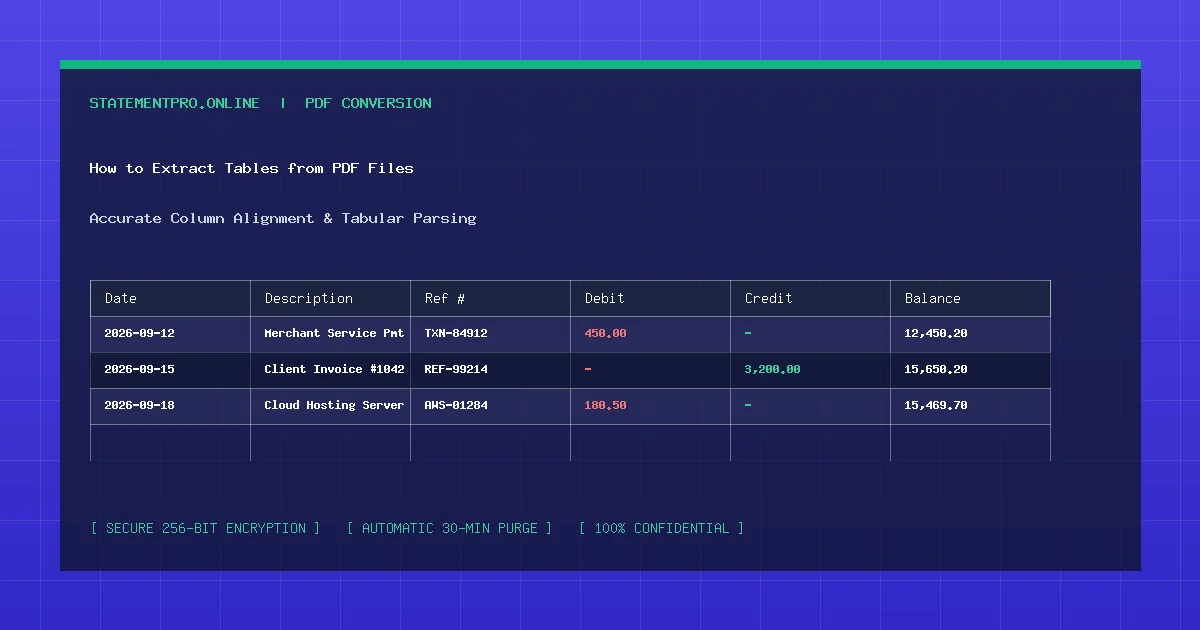
Documents in business, research, engineering, and finance are filled with dense tabular data. Invoices, financial statements, scientific reports, and pricing manifests present critical records in structured grids. However, because the PDF specification does not inherently understand the concept of an HTML-like table or spreadsheet grid, extracting those figures into editable formats is notoriously difficult. If you have ever tried copying a table from a PDF only to end up with a single jumbled text column in Excel, learning how to properly extract tables from PDF files will revolutionize your workflow.
What Is PDF Table Extraction?
PDF table extraction is the algorithmic recovery of two-dimensional tabular data structures (rows and columns) from the visual presentation layer of a PDF document. Unlike spreadsheets where cells are explicitly defined by grid coordinates (such as cell B4), a PDF represents content as individual floating text characters positioned at arbitrary Cartesian coordinates (X and Y coordinates measured in points from the bottom-left corner of the page).
Extracting a table requires a software parser to reconstruct the visual boundaries of rows, detect whitespace gutters between columns, and group fragmented text fragments into coherent cell records.
Why Is Extracting Tables from PDF Files Useful?
Tabular data trapped in PDF documents is effectively frozen. Extracting tables into structured environments like Excel, CSV, or SQL databases provides vital operational advantages:
- Empowers Quantitative Analysis: Run statistical regressions, forecasting models, and financial audits on historical datasets that were previously locked in static publications.
- Accelerates Data Integration: Ingest vendor price lists, product catalogs, and shipping manifests directly into database management systems without paying data entry clerks.
- Guarantees Audit Accuracy: Automated extraction prevents human fatigue errors, such as transposing digits or skipping rows during lengthy multi-page data transfers.
- Enables Cross-Document Comparison: Consolidate tabular summaries from dozens of disparate PDF reports into a single unified analytical database.
How Do Table Extraction Algorithms Work?
Modern table extraction methodologies fall into two primary architectural categories:
- Lattice Extraction (Border-Based): When a PDF table contains explicit visible horizontal and vertical ruling lines, the extraction engine detects intersecting vector path lines (drawn via PDF operators such as
m,l, andre). The intersections form bounding boxes, allowing the engine to map enclosed text strings directly to corresponding table cells. - Stream Extraction (Whitespace-Based): For borderless tables, the parser evaluates horizontal whitespace gaps between text elements. By projecting vertical alignment axes across all lines on the page, the algorithm discovers implicit column channels and assigns words to rows based on vertical proximity.
Step-by-Step Guide: How to Extract PDF Tables Efficiently
Follow these steps to extract tables from your documents using StatementPro:
Step 1: Inspect the Source PDF Table Structure
Open your PDF file and examine the target tables. Check whether the document contains selectable text by highlighting a sentence with your cursor. If text is selectable, the file is a native digital PDF ready for immediate stream parsing. If the document is an image scan, OCR processing must be applied first.
Step 2: Upload Your File to StatementPro
Navigate to the StatementPro PDF to Excel Tool. Drag your document into the upload module. StatementPro supports multi-page files containing tables distributed across consecutive pages.
Step 3: Select Your Preferred Output Architecture
Choose Excel (.xlsx) if you wish to retain grid lines, column formatting, and auto-sized cells, or select CSV (.csv) if you plan to pipe the raw data into an analytical script or database.
Step 4: Execute Extraction and Validate Columns
Click Start Conversion. Once the parsing pipeline completes, inspect the live preview grid to confirm that header labels align accurately with their underlying data columns, then click Download File.
Practical Example: Fictional Multi-Column Table Extraction
Consider an extracted quarterly procurement manifest containing inventory data:
| SKU Item | Product Description | Unit Cost | Quantity | Total Valuation |
|---|---|---|---|---|
| PRD-104 | Industrial Steel Bearing #8 | $45.20 | 250 | $11,300.00 |
| PRD-219 | High-Pressure Hydraulic Seal | $18.75 | 600 | $11,250.00 |
| PRD-330 | Synthetic Lubricant Drum 55Gal | $310.00 | 40 | $12,400.00 |
| PRD-412 | Precision Calibration Sensor | $125.50 | 120 | $15,060.00 |
When properly extracted, numeric columns like Unit Cost and Quantity are treated as pure numbers in Excel, allowing immediate multiplication via =C2*D2 to verify total valuations.
Common Problems in PDF Table Extraction
- Colspan and Merged Header Cells: In complex reports, high-level headers frequently span two or three sub-columns (e.g., "Fiscal 2026" spanning "Q1" and "Q2"). Poor parsers duplicate text or shift child columns out of alignment.
- Wrapped Cell Text Creating Artificial Rows: If a description is long, it may wrap onto a second line within the cell. Naive text splitters interpret the second line as a brand new table row.
- Inconsistent Column Gutters: Tables with uneven spacing between columns can cause numbers from column B to bleed into column C during whitespace-based parsing.
Common Mistakes to Avoid
- Copying and Pasting Directly into Excel: Standard clipboard copy operations discard column coordinate data, pasting entire rows into single monolithic cells.
- Ignoring Table Continuation Headers: When a table spans across page breaks, the header row is often repeated at the top of each page. Be sure to filter out redundant mid-table headers after extraction.
- Overlooking Footnotes and Annotations: Tables frequently include footnote symbols (* or †) inside numeric cells. If uncleaned, Excel treats the figure as text rather than a calculable number.
Privacy and Data Protection
Tables frequently contain proprietary business metrics, pricing negotiations, or customer registries. StatementPro safeguards your data through modern security protocols:
- All uploads are encrypted via HTTPS with TLS 1.3 protocol.
- Documents are parsed in ephemeral memory buffers without persistent disk writes.
- Files are permanently purged from server memory within 30 minutes.
- No documents are indexed, logged, or shared with third-party networks.
Limitations of Table Extraction
While automated tools excel at standard tabular layouts, non-traditional tables—such as nested tables inside tables, diagonal column orientations, or tables embedded as low-resolution raster graphics—may require post-extraction data cleaning in Excel.
Frequently Asked Questions
Can I extract tables spanning multiple PDF pages?
Yes. StatementPro recognizes continuous table layouts across page breaks and concatenates data rows into a single unified spreadsheet table.
What is the difference between lattice and stream extraction?
Lattice extraction detects explicit visual grid lines to form cell boundaries. Stream extraction evaluates whitespace spacing to identify columns in borderless tables.
Why did my numbers turn into dates in Excel?
If a table contains hyphenated codes or fraction numbers (e.g., 3-5 or 10/12), Excel may automatically interpret them as calendar dates. Format the column as Text to preserve the original characters.
Related StatementPro Tools
- PDF to Excel Converter: Extract PDF tables into fully formatted Excel (.xlsx) workbooks.
- PDF to CSV Converter: Export tabular data into clean Comma-Separated Values.
- CSV to Excel Converter: Turn raw extracted data files into polished spreadsheets.
Related Guides & Tutorials
- How to Convert PDF Tables Into Spreadsheet Data
- Why PDF Tables Sometimes Convert Incorrectly
- How to Clean Data After PDF to Excel Conversion
- How to Extract Data from a PDF
Conclusion
Mastering how to extract tables from PDF files transforms static reports into actionable datasets. By leveraging specialized table extraction engines like StatementPro, you can extract multi-column business records, financial schedules, and inventory manifests in seconds with zero manual typing.